How a voice agent works and what it must never do
A phone assistant listens, decides how to respond, and speaks. It should use approved information, confirm bookings, and hand over when unsure.
Need a word explained? Open the glossary →
Full lesson & technical details
Speech-to-text, the model, text-to-speech and telephony in a 500 ms loop; where latency comes from; and the three rules (knowledge base only, confirm before booking, hand off when unsure) that keep clients safe.
The loop
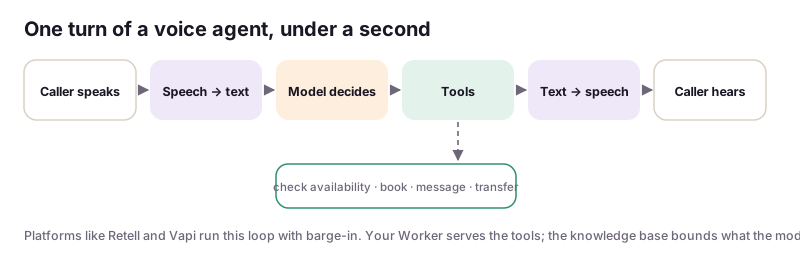
Caller speaks → speech-to-text streams words → the language model decides what to say and whether to call a tool → text-to-speech streams audio back → telephony carries it. Platforms like Retell and Vapi run this loop with 300–800 ms turn latency, handle interruptions (barge-in) and expose tools (functions) the model can call mid-call: check availability, book, transfer.
Where the money goes
Per-minute pricing stacks the layers: voice infrastructure, speech-to-text, the model, text-to-speech, telephony. Retell quotes all-in rates in roughly the $0.07–$0.31 per minute range depending on voice and model; Vapi charges about $0.05 per minute for the platform and passes model and voice costs through, landing around $0.10–$0.30 all-in. A receptionist averaging 3-minute calls, 150 calls a month, costs you $45–$135 in minutes. Price the service at $300–$900 and the margin is obvious.
The three rules
- Knowledge base only. The agent may state facts only from the client’s approved knowledge base: hours, services, prices, policies, directions, insurance accepted. Anything else: “I don’t have that information, but I can take a message or book you a call with the team.”
- Confirm before committing. Before any booking, the agent reads back name, phone, service, date and time and waits for a yes. Numbers and names are repeated digit by digit and spelled when unclear.
- Hand off when unsure or urgent. Keywords (emergency, pain, lawyer, complaint, cancel my account) trigger a transfer to a human or an immediate text to the owner with the transcript. The agent never argues and never gives medical or legal advice.
What you are selling
Not “AI.” You are selling: no missed calls, appointments booked at 9 pm, a transcript of every call, and the owner’s phone not ringing during dinner. Lead with the missed-call number: ask the client how many calls went to voicemail last month; most have no idea, and the first week’s report tells them.
Worked example
Caller: Do you guys do Botox for migraines, and is it covered by insurance?
Agent: We do offer Botox at Glow Aesthetics; for migraine treatment specifically and insurance questions, I don’t have that information, and I don’t want to guess. I can book you a free 15-minute consultation with Tasha, who can answer both. Would tomorrow at 2 pm or Thursday at 10 am work?
It stayed inside the knowledge base, declined to give medical or insurance advice, and moved to a booking.
Instructions you can copy (prompts)
Copy the instructions, replace the words inside {braces} with your details, and paste them into your AI tool. Check and edit the answer.
Write a 15-minute discovery call script for selling an AI receptionist to {business type}: five questions that surface missed calls, after-hours demand, booking process and the owner’s pain, a two-minute explanation of what the agent does in plain language with the three safety rules, the live demo moment (I call the demo number and book), objection answers for “callers will hate a robot”, “what if it books wrong” and “what about emergencies”, and a close that offers a two-week pilot. Keep it conversational, no jargon.Write the discovery script for one business type you want to sell to, and list the five knowledge-base categories that business would need. Paste both.
Done when: A script you could run tomorrow and a knowledge-base outline for your target niche.. Sign up to save your work to your account.
Quick knowledge check
3 questions, 60% passes. Checkpoints, the certification exam (three versions) and the reviewed final project are unlocked with a free account.
- A voice agent’s typical turn latency on modern platforms is:
- The agent may state facts from:
- Before booking, the agent must: