Find the argument before the slides
Audience, decision, one sentence, three reasons with proof, and the ask. The brief that turns rough notes into a deck that persuades.
Need a word explained? Open the glossary →
Full lesson & technical details
Audience, decision, one sentence, three reasons with proof, and the ask. The brief that turns rough notes into a deck that persuades.
The one-sentence test
Write: “By the last slide, [audience] should believe [claim] because [reason 1], [reason 2], [reason 3], and should [action].” If the client cannot fill this in (or you cannot from their notes), there is no deck yet; there is a conversation. Fill it on a 20-minute call.
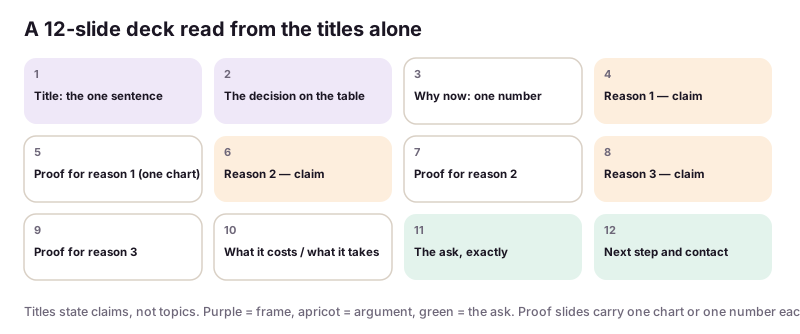
Audience and decision
Who is in the room, what they already believe, what they fear, and the decision they make afterwards (fund, buy, approve, learn, change behavior). A board deck and a sales deck about the same business are different decks because the decision differs.
Three reasons, with proof
Each reason gets one proof: a number, a story, a demonstration, a comparison. No proof, no reason. Three is the limit an audience remembers.
The ask
One concrete next step with a date: “Approve the $40k pilot by Friday.” Decks that end with “Questions?” end with nothing.
Time and venue
Ten minutes means ten slides at most. Presented live, slides carry less text; emailed as a leave-behind, they carry more (make two versions). Printed, no dark backgrounds.
Turning notes into the brief
Clients send a wall of bullet points. Ask the AI to find the claim and the three strongest reasons in the notes, then confirm with the client. The confirmed brief is the scope; new reasons later are a change request.
Worked example
By the last slide, the HR director should believe that a monthly 45-minute strength session cuts the team’s back-pain sick days, because (1) 38% of their absences last year cited back or neck pain (their own HR data), (2) members of my 12-week program reported 62% fewer pain days (survey, n=84), and (3) the session costs less than one lost day per quarter ($450 vs $1,100), and should approve a three-month pilot for the Austin office by March 15.
Instructions you can copy (prompts)
Copy the instructions, replace the words inside {braces} with your details, and paste them into your AI tool. Check and edit the answer.
Here are the client’s rough notes for a presentation: {paste notes}. Audience: {audience}. Decision they should make afterwards: {decision}. Time: {minutes} minutes. Fill in: “By the last slide, [audience] should believe [claim] because [reason 1], [reason 2], [reason 3], and should [action by date].” Propose the three strongest reasons found in the notes with one proof each (number, story, comparison) and flag which proofs are missing or need a source. Then list what in the notes should be cut from the deck and kept for Q&A or an appendix.
Build the brief for Nora’s corporate wellness talk pitch (capstone page) or a real client’s notes. Paste the one sentence and the three reasons with proof.
Done when: A one-sentence argument with three proven reasons and a dated ask.. Sign up to save your work to your account.
Quick knowledge check
3 questions, 60% passes. Checkpoints, the certification exam (three versions) and the reviewed final project are unlocked with a free account.
- If the one sentence cannot be filled in:
- How many reasons?
- The last slide is: