Outcomes first, then the curriculum
Start from what the student can do at the end, work back to modules and lessons, and give every lesson a thing it produces, so the course is a path and not a lecture series.
Need a word explained? Open the glossary →
Full lesson & technical details
Start from what the student can do at the end, work back to modules and lessons, and give every lesson a thing it produces, so the course is a path and not a lecture series.
The outcome statement
“After this course, a [who] can [do what] without [the obstacle].” One sentence, specific, measurable in the student’s life (“can run a 30-minute discovery call that ends with a next step”, not “understands sales”). The expert signs it. Everything in the course serves it or is cut.
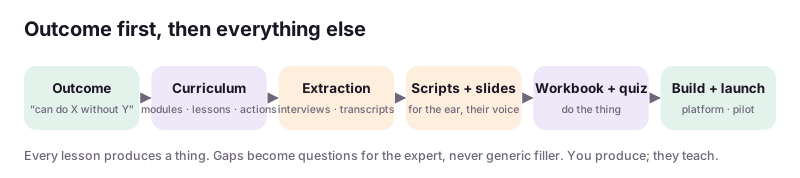
Backward design
From the outcome: what must the student be able to do (3–6 capabilities)? For each: what do they need to know, what do they need to practice, and what artifact proves it? Capabilities become modules; knowledge + practice become lessons; artifacts become the workbook.
The curriculum sheet
Module → lesson → the lesson’s outcome (“student has a filled-in call script”) → format (video 8–12 min, worksheet, checklist, demo, live call) → length → assets needed → status. Lessons 6–12 minutes; modules 3–5 lessons; courses 4–8 modules. Shorter than the expert wants; students finish short courses.
The first lesson and the last
Lesson 1: the outcome, the path, the quick win in 10 minutes (something they do today). Last lesson: the artifact review, what to do next week, the next offer. The middle earns the ending.
What students actually do
Every lesson ends with an action (fill this, write that, record this, send that). A course with no actions has a 5% completion rate; a course where each lesson produces a thing gets finished and gets testimonials.
Worked example
Outcome: After this course, a mid-career professional who feels stuck can name two realistic next roles and run three informational conversations without freezing. Modules: 1 Where you are (energy audit, values sort) → 2 What you could do (role map, reality checks) → 3 Talking to people (the ask, the 20-minute conversation, the follow-up) → 4 Deciding and moving (criteria, the 90-day plan). Quick win in lesson 1.1: the “last five Mondays” energy audit (10 minutes).
Instructions you can copy (prompts)
Copy the instructions, replace the words inside {braces} with your details, and paste them into your AI tool. Check and edit the answer.
Help me design a course for {expert and topic}. Audience: {who}. Draft 3 outcome statements in the form “After this course, a [who] can [do what] without [obstacle]”; pick the strongest and explain why. Then backward-design: 3–6 capabilities the student needs for that outcome; for each, the knowledge, the practice and the artifact that proves it. Turn capabilities into modules (4–8) and lessons (3–5 per module, 6–12 minutes each), each lesson with: title, outcome (“student has…”), format, length, assets needed, and the action the student takes at the end. Lesson 1 includes a 10-minute quick win; the last lesson includes the artifact review and next steps. Present as a table.
Design the outcome and curriculum for Lena’s Career Clarity course (capstone page) or a course for an expert you know. Paste the outcome statement and the module list with lesson outcomes.
Done when: A signed-off outcome, 4–8 modules, every lesson with a thing it produces.. Sign up to save your work to your account.
Quick knowledge check
3 questions, 60% passes. Checkpoints, the certification exam (three versions) and the reviewed final project are unlocked with a free account.
- Course design starts with:
- Every lesson ends with:
- Lesson length target: