The audit and the rules
Audit a business across platforms: ratings, counts, recency, response rate, themes, and the rating math; and learn the rules that keep the work legal and the profile unbanned.
Need a word explained? Open the glossary →
Full lesson & technical details
Audit a business across platforms: ratings, counts, recency, response rate, themes, and the rating math; and learn the rules that keep the work legal and the profile unbanned.
The audit
Per platform: rating, review count, reviews in the last 90 days (recency matters to Google), owner response rate and speed, the distribution (how many 1-star), the themes in the last 30 reviews (what customers praise and complain about), photos, and the Q&A section. Competitors: the same for three nearby. The gap is the pitch.
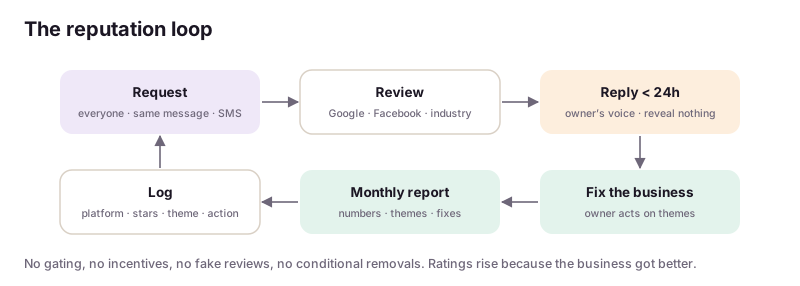
The rating math
A 4.1 with 40 reviews needs about 25 new 5-star reviews to reach 4.5. Show the client the number; it makes the request system the obvious first step. (Rating = sum of stars ÷ count; compute the 5-stars needed for the target.)
The rules (and why)
- No gating: you ask everyone, not just the happy ones (Google policy; FTC). The request is the same message to all customers.
- No incentives for reviews on Google (discounts, entries, gifts); Yelp discourages asking at all and filters solicited reviews.
- No fake reviews: not from staff, family, bought lists, or AI-generated “customers”; FTC fines up to tens of thousands per violation; Google removes the profile.
- Privacy in replies: never confirm someone was a patient or client, never mention their treatment, visit or details (HIPAA for medical; good practice everywhere). “We take every piece of feedback seriously” and a private channel.
- No arguing, no threats, no outing the reviewer, no mentioning lawyers in a reply.
What you can do
Ask everyone at the right moment with a direct link; reply to everyone; flag reviews that violate policy (spam, competitor, off-topic, conflict of interest, personal attacks); fix the operational problems the reviews reveal; use real reviews in marketing with the reviewer’s name as shown publicly.
Worked example
Google 4.2 (87 reviews; 6 in last 90 days; owner replies to 18%; nine 1-stars). Yelp 3.5 (22). Facebook 4.6 (31). Praise: results, Dr. Amara, cleanliness. Complaints: wait times (11 mentions), front desk tone (7), pricing surprises (5). Math: to reach 4.5 on Google needs 27 more 5-star reviews at the current count. Risk: two replies name the treatment the reviewer had → HIPAA exposure; rewrite and train.
Instructions you can copy (prompts)
Copy the instructions, replace the words inside {braces} with your details, and paste them into your AI tool. Check and edit the answer.
Audit this business’s review profile from the data I paste (per platform: rating, count, last-90-day count, response rate, 1-star count, and the text of the last 30 reviews): {paste}. Competitors: {paste competitors}. Produce: a scorecard per platform; the top five praise themes and top five complaint themes with example phrases; the response gaps; the rating math (how many 5-star reviews to reach {target rating}); the compliance risks visible (gated requests, incentives, staff reviews, replies revealing client details); and a prioritized 30-day plan.
Audit Glow Lab Med Spa (capstone page) or a local business you know across Google, Yelp and Facebook; compute the rating math and list the themes. Paste the scorecard and the 5-star number.
Done when: A scorecard with themes, gaps and a concrete number of reviews needed.. Sign up to save your work to your account.
Quick knowledge check
3 questions, 60% passes. Checkpoints, the certification exam (three versions) and the reviewed final project are unlocked with a free account.
- Review gating is:
- In a reply to a med spa review you may:
- Offering a discount for a Google review is: