Transcript to moment map
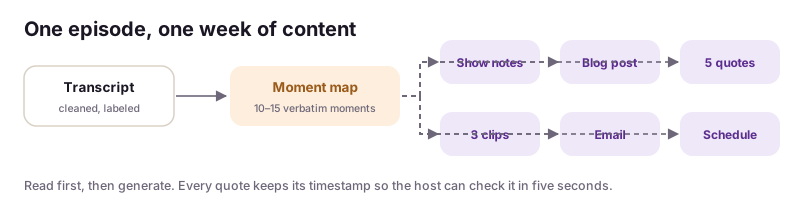
Clean up the transcript and label who is speaking. Pick the useful stories, advice, and quotes, keeping timestamps so each can be checked.
Need a word explained? Open the glossary →
Full lesson & technical details
Clean the transcript, label speakers, then find the 10–15 moments worth anything (argument, story, number, laugh, disagreement, advice) with timestamps, before generating a single asset.
Clean first
Export the transcript with timestamps. Fix speaker labels (Host / Guest), remove filler if the tool did not, and keep the timestamps every 30–60 seconds. Paste into the workspace as a file. Hour-long transcripts are 8,000–10,000 words; Claude takes it whole, ChatGPT may need halves.
The six moment types
- The argument: the one claim the episode makes (there is usually one). Becomes the blog post and the email.
- The story: a guest’s turning point with a specific detail. Clip and quote.
- The number: a statistic or a concrete figure (“I applied to 140 jobs”). Quote graphic.
- The laugh: the funniest 15 seconds. Clip.
- The disagreement or surprise: where host and guest differ or the guest says the unexpected thing. Clip with a hook.
- The advice: the one thing a listener can do tomorrow. Quote, email CTA.
The moment map
A table of 10–15 rows: timestamp, type, the verbatim quote (20–60 words), why it works, intended use (clip / quote / blog / email). You read the transcript to build this; the AI helps find candidates but you choose. The map is also the host’s review surface: they approve moments in two minutes, and nothing downstream surprises them.
Verbatim means verbatim
Quotes are copied from the transcript, trimmed only at the ends, with “[…]” for cuts and the timestamp attached. If the transcript garbled a word, listen to the audio at that timestamp. One invented quote ends the engagement.
Worked example
| Time | Type | Quote | Why | Use |
|---|---|---|---|---|
| 12:40 | number | “I applied to 140 UX jobs in nine months. I got four interviews. Two were because a nurse I’d worked with knew someone.” | Concrete, humbling, proves the network point | quote, clip |
| 27:15 | surprise | “The thing nobody tells you: your old job is your portfolio. I designed a medication-tracking flow from triage memory.” | Flips the ‘start from zero’ assumption | clip (hook), blog |
| 44:02 | advice | “Pick one hospital problem you hated and redesign it this weekend. That’s the first case study.” | Doable tomorrow | email CTA, quote |
Instructions you can copy (prompts)
Copy the instructions, replace the words inside {braces} with your details, and paste them into your AI tool. Check and edit the answer.
Here is the cleaned transcript of episode {number} of {show} with guest {guest} (attached or pasted). Find 20 candidate moments across these types: the argument, story, number, laugh, disagreement/surprise, advice. For each: timestamp, type, the verbatim quote copied exactly from the transcript (20–60 words, trim only at the ends, mark cuts with […]), one line on why it works, and a suggested use (clip/quote/blog/email). Do not paraphrase inside quotes. Flag any quote where the transcript looks garbled so I can check the audio.
Take any podcast episode with a transcript (or the sample episode on the capstone page), build the moment map with 10–15 rows, and paste five rows.
Done when: A moment map with timestamps, verbatim quotes and uses the host could approve in two minutes.. Sign up to save your work to your account.
Quick knowledge check
3 questions, 60% passes. Checkpoints, the certification exam (three versions) and the reviewed final project are unlocked with a free account.
- What comes before generating any asset?
- A quote in a graphic must be:
- The episode’s “argument” becomes: