Choose the one problem
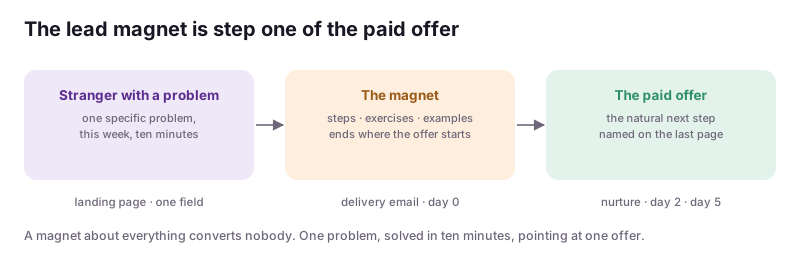
The magnet solves one specific problem the ideal buyer has this week, in ten minutes, and ends where the paid offer starts. How to pick it, name it and format it.
Need a word explained? Open the glossary →
Full lesson & technical details
The magnet solves one specific problem the ideal buyer has this week, in ten minutes, and ends where the paid offer starts. How to pick it, name it and format it.
The three tests
- Specific: “Write your first case study this weekend” beats “Career change guide”.
- Fast: usable in ten minutes; a result the reader can feel today.
- Adjacent to the offer: the magnet is step one of what the paid offer does fully. A course on career clarity gets a “three questions that reveal your next role” worksheet; its last page says “the course does the other nine”.
Where the problem comes from
The client’s most-asked question (emails, DMs, calls), the first module of their course, the thing they explain on every sales call. Ask: “What do people ask you that you answer the same way every time?”
Formats and when
- Checklist (1–3 pages): a process with steps; fastest to make; great for services and shops.
- Guide (5–8 pages): a how-to with examples; for expertise-led brands.
- Workbook (8–12 pages): exercises with answer lines; for coaches and courses; highest perceived value.
- Template or swipe file: fill-in documents; for writers, marketers.
- Quiz (via Typeform or the email tool): highest opt-in rate, most setup; the premium tier.
Naming
“[Outcome] in [time]: [format]”, specific noun, no “ultimate”. “The 3-question worksheet that reveals your next career move”. The title is the landing page headline too.
The brief
Problem, who has it, the ten-minute outcome, format, the bridge sentence to the offer, proof the client has, and three examples from their experience to use inside. Client approves the brief; it is the scope.
Worked example
- Checklist: “Is it time to change careers? The 12-sign checklist” (fast, but ends in doubt, weak bridge).
- Workbook: “The 3-question worksheet that reveals your next career move” (10 pages; ten-minute outcome: a shortlist of two directions; bridge: the course turns the shortlist into a plan and a first case study). Pick.
- Template: “The career-change story template for interviews” (useful later in the journey; better as a module bonus).
Instructions you can copy (prompts)
Copy the instructions, replace the words inside {braces} with your details, and paste them into your AI tool. Check and edit the answer.
The client {business} sells {offer} to {audience}. Their most-asked questions: {questions}. From these, propose three lead magnet options; for each give: the one specific problem, the ten-minute outcome, the format (checklist/guide/workbook/template/quiz) with page count, a title in the form “[outcome] in [time]: [format]” (no “ultimate”), and the one-sentence bridge to the paid offer. Recommend one and say why. Then draft the magnet brief for it with three places to use the client’s own examples.
Choose the problem and format for Lena’s Career Clarity course (capstone page) or a real client, and write the brief. Paste the title, the outcome and the bridge sentence.
Done when: A specific, fast, offer-adjacent magnet with a brief the client can approve.. Sign up to save your work to your account.
Quick knowledge check
3 questions, 60% passes. Checkpoints, the certification exam (three versions) and the reviewed final project are unlocked with a free account.
- A good lead magnet solves:
- The magnet should end:
- The problem comes from: