Sharpen the question and the criteria
Research that helps starts from a decision: who decides what, by when, with which criteria. The 15-minute intake that turns “look into CRMs” into a question you can answer.
Need a word explained? Open the glossary →
Full lesson & technical details
Research that helps starts from a decision: who decides what, by when, with which criteria. The 15-minute intake that turns “look into CRMs” into a question you can answer.
From topic to question
“Look into CRMs for us” is a topic. “Which of HubSpot, Pipedrive, Follow Up Boss or a Zoho plan should a 42-tech HVAC company with three branches adopt in Q1, given it must integrate with ServiceTitan-style dispatch, cost under $150 per user per year, and be usable by technicians on phones?” is a question. The difference is the decision, the constraints and the criteria.
Intake questions
- “What decision will this inform, who makes it, and when?”
- “What would make an option a no, no matter what?” (must-haves)
- “What would make you pick one over another?” (nice-to-haves, weighted)
- “What do you already believe, and what would change your mind?”
- “What is out of scope?”
Criteria and weights
Six to ten criteria, each with a weight (must-haves are pass/fail; the rest 1–3). Write them down before researching so the answer is not shaped by what you happen to find first.
Scope and time
A 48-hour brief covers 3–6 vendors or 5–8 competitors on 8–10 criteria from public sources. Interviews, demos and data pulls are the premium tier. Say what the brief will not do.
The brief’s shape, agreed up front
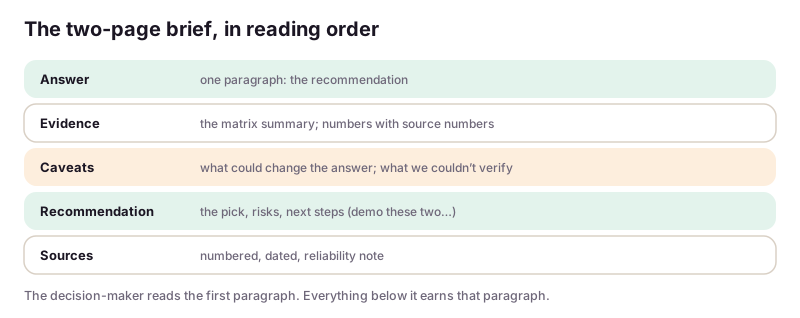
Two pages: the answer in three lines, then evidence, caveats, recommendation, next steps, sources. Clients who see the shape before you start do not ask for a 20-page report after.
Worked example
| Criterion | Type | Weight | Definition |
|---|---|---|---|
| Mobile app usable by technicians | must-have | pass/fail | Native iOS/Android app with offline notes |
| Dispatch integration | must-have | pass/fail | Native or Zapier/API integration with the dispatch tool |
| Cost per user per year | must-have | pass/fail | ≤ $150 at 45 users |
| Quote and follow-up automation | nice | 3 | Sequences for unsent quotes |
| Reporting by branch | nice | 2 | Dashboards filterable by location |
| Ease of setup | nice | 2 | Self-serve import, under two weeks |
| Support quality | nice | 1 | Phone support, review sentiment |
Instructions you can copy (prompts)
Copy the instructions, replace the words inside {braces} with your details, and paste them into your AI tool. Check and edit the answer.
A client said: “{topic request}”. Context: {business}, {situation}. Draft the research question in one sentence naming the decision, the decider, the deadline and the constraints; list 6–10 criteria split into must-haves (pass/fail) and weighted nice-to-haves (1–3) with a one-line definition each; state what is out of scope for a 48-hour public-source brief; and write five intake questions to confirm all of this with the client in 15 minutes.
Turn Bell Mechanical’s request (“look into a CRM for the techs”, capstone page) into a research question with criteria and weights. Paste the question and the criteria table.
Done when: A decision-shaped question with pass/fail must-haves and weighted criteria, agreed before research.. Sign up to save your work to your account.
Quick knowledge check
3 questions, 60% passes. Checkpoints, the certification exam (three versions) and the reviewed final project are unlocked with a free account.
- A research question names:
- Criteria are written:
- A must-have criterion is scored: