The localization brief: audience, variant, register
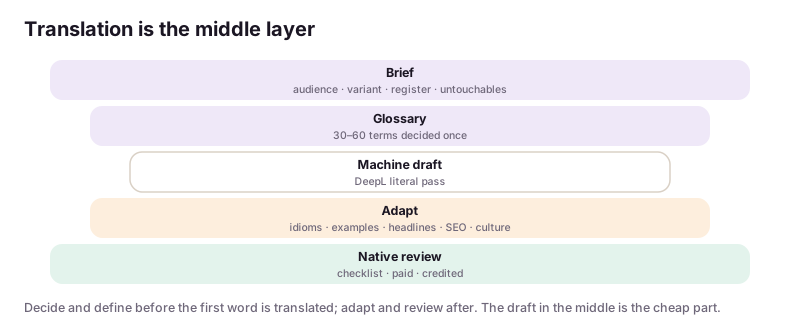
Who reads it, which regional variant, formal or informal address, what stays untouched, and what must be adapted rather than translated. Decide before translating a word.
Need a word explained? Open the glossary →
Full lesson & technical details
Who reads it, which regional variant, formal or informal address, what stays untouched, and what must be adapted rather than translated. Decide before translating a word.
Translation vs localization
Translation changes the words. Localization changes what is needed so the copy does the same job for a different reader: idioms, examples, currency and dates, images, humor, legal lines, even the offer. “Same-week scheduling” might become “we come this week” if the local phrase sells better.
Variant
Spanish for Mexico and the US Southwest is not Spanish for Spain; Brazilian and European Portuguese differ; French for Quebec differs from France. Ask who the readers are, pick one variant, write it in the brief, and keep it.
Register (the first decision)
Formal or informal address (usted vs tú, Sie vs du, vous vs tu) changes every sentence. A dentist to families in Texas: usted on the site, tú on Instagram is a common split. Decide per channel and note it.
Do-not-translate and must-adapt
Do not translate: brand names, product names the client wants kept, hashtags they own, legal names, addresses. Must adapt: prices (currency, format), dates and times, phone formats, measurements, holidays and seasons, testimonials (translate only with permission; label), images with text, culturally specific references.
Legal and medical lines
Consent forms, policies, medication instructions, safety warnings: route to a certified translator or mark as excluded. Marketing copy that mentions them links to the certified version.
The brief
One page: audience and variant, register per channel, tone words from the F1 voice guide, do-not-translate list, must-adapt list, exclusions, SEO intent (which pages must rank in the target language), and the reviewer.
Worked example
Variant: Spanish (US/Mexico). Register: usted on the website and forms; tú on Instagram and stories. Do not translate: Brightside Family Dental, Invisalign, the membership plan name. Adapt: prices stay USD with “$129” but “X-rays” becomes “radiografías”; Saturday hours written “sábados 9 a.m.–1 p.m.”; the “new patient special” framed as “oferta para pacientes nuevos”; the testimonial from Mrs. Alvarez used only with written permission; the hero image text (“Smile with confidence”) needs a Spanish version in Canva. Excluded: consent forms and the privacy policy (certified translator).
Instructions you can copy (prompts)
Copy the instructions, replace the words inside {braces} with your details, and paste them into your AI tool. Check and edit the answer.
Draft a localization brief for {business} ({type}) translating {content} from {source language} to {target language} for readers in {region}. Decide and justify: the regional variant; register per channel (site, social, email); 5 tone words adapted from this voice guide {voice}; the do-not-translate list (brands, product names, hashtags, legal names); the must-adapt list (prices, dates, phone formats, holidays, testimonials, images with text, references); exclusions needing a certified translator; which pages need target-language SEO. Mark anything to confirm with the client as ASK.
Write the brief for Brightside Family Dental’s Spanish site and Instagram (capstone page) or a real client. Paste the register decision and the must-adapt list.
Done when: A brief that fixes variant, register and what stays untouched before any translation.. Sign up to save your work to your account.
Quick knowledge check
3 questions, 60% passes. Checkpoints, the certification exam (three versions) and the reviewed final project are unlocked with a free account.
- Localization differs from translation because it:
- Register is decided:
- Consent forms and safety warnings are: